Many people in the piping industry use “ANSI flange” and “ASME flange” as if they are different things. This article explains what these terms mean today. The short answer is that for modern flanges, there is usually no practical difference. They often refer to the same physical part.
Here is a simple breakdown of the relationship:
| Term | What It Stands For | What It Means for Flanges |
| ANSI | American National Standards Institute | The organization that approves and accredits standards. It sets the “framework.” |
| ASME | American Society of Mechanical Engineers | The organization that writes and maintains the technical standards for flanges. |
| ASME B16.5 | The Specific Standard | This is the actual rulebook. It defines all dimensions, materials, and pressure ratings for pipe flanges. |
The History and Why Both Names Are Used
To understand why both names exist, it helps to know a bit of history.
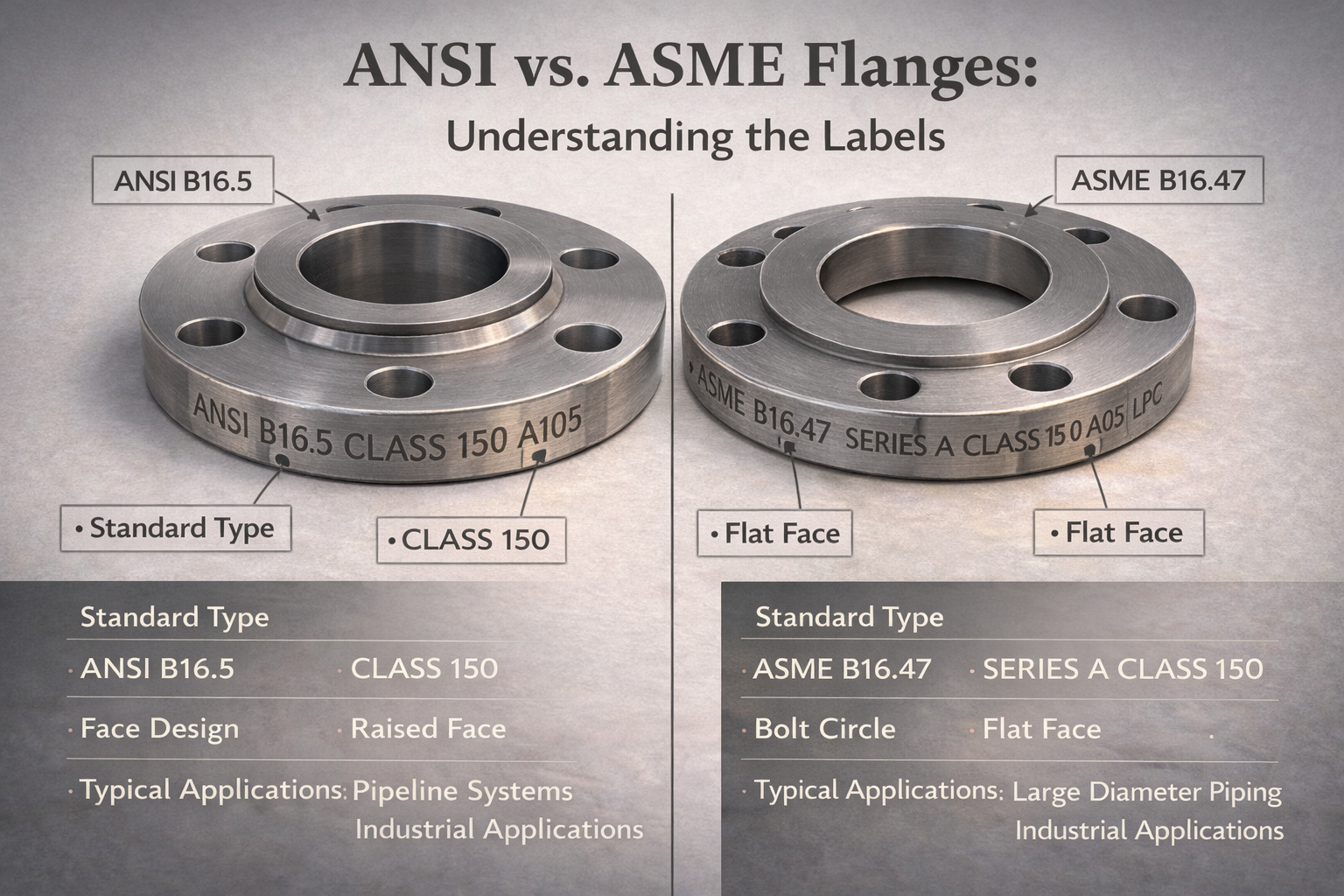
Originally, the American National Standards Institute (ANSI) published its own flange standards, like ANSI B16.5. For decades, engineers and buyers said “ANSI flanges” and everyone knew what they meant.
Over time, the American Society of Mechanical Engineers (ASME) took over the writing and maintenance of these piping codes. The standard was re-designated as ASME B16.5. The content, dimensions, and pressure classes stayed the same.
So, when someone says “ANSI Class 150 Flange,” they are using the old, common name. When they say “ASME B16.5 Class 150 Flange,” they are using the current, precise technical name. They are almost certainly talking about the same part.
How to Read Flange Specifications Today
When you order flanges, the exact standard written on the specification matters most.
- Modern Standards: Look for ASME B16.5 (for flanges NPS 1/2″ to 24″) or ASME B16.47 (for large flanges NPS 26″ to 60″). These are the active standards.
- Common Language: It’s still very normal to hear terms like “ANSI 150” or “ANSI 300” on the job site or in conversation. This refers to the pressure class from the old system, which is identical in the new one.
- What Doesn’t Change: The critical dimensions—outside diameter, bolt circle, thickness, and pressure-temperature ratings—are identical whether you call it ANSI or ASME B16.5.
Other Important Flange Standards
While ASME B16.5 is the primary standard in the US, other standards exist for specific applications. It’s useful to know them.
- API Flanges (e.g., API 6A): For wellhead and Christmas tree equipment in oil and gas. They often use Ring-Type Joint (RTJ) faces for very high pressure.
- MSS SP Standards: From the Manufacturers Standardization Society. MSS SP-44 is for large-diameter steel flanges (now also covered by ASME B16.47 Series A).
- AWWA Flanges: From the American Water Works Association for water service pipelines. Common standards are AWWA C207 for steel pipe flanges.
- DIN / EN / JIS: International standards from Europe (DIN/EN) and Japan (JIS). Their dimensions and pressure ratings (like PN ratings) are different from ASME. They are generally not interchangeable with ANSI/ASME flanges.
What This Means for Your Projects
- Focus on the Details: When specifying flanges, always list the full standard. Say “ASME B16.5 Class 150 Weld Neck Flange, Material A105” instead of just “ANSI 150 Flange.” This avoids any confusion.
- Check the Specs: If you are working with old drawings that say “ANSI B16.5,” you can safely substitute an “ASME B16.5” flange. The parts are compatible.
- Don’t Worry About Interchangeability: You can bolt a flange marked “ASME B16.5” to a flange marked “ANSI B16.5” of the same size and class. They will fit.
Frequently Asked Questions
Q: So, is there any difference I need to worry about?
A: For standard pipe flanges, no. The parts are the same. The difference is just in the name on the standard document.
Q: Which term should I use on my purchase orders?
A: Use the current, correct term: ASME B16.5. This is the most precise and avoids any ambiguity with other standards.
Q: What about “ANSI Class” versus “ASME Class”?
A: They are the same. “Class 150” means the same pressure-temperature rating whether it’s from the old ANSI standard or the current ASME standard.
Q: Are all flanges made to ASME standards?
A: No. Some are made to other standards like API, AWWA, or DIN for specific applications. Always confirm the governing standard for your project.
Conclusion
The “ANSI vs. ASME” debate is mostly about terminology, not engineering. ANSI accredits the standard, and ASME writes it. The flanges you buy today are made to ASME B16.5. When you hear “ANSI flange,” it usually just refers to the pressure class system defined in that standard.
The key is to specify the complete standard, material, and type to get the exact part you need for a safe and functional piping system.
Need help specifying the correct ASME B16.5 flanges for your project? We supply flanges in all pressure classes, types, and materials, with full traceability to the required standards. Get a precise quote here: http://texasflange.com/lp12/